
Technology Partner for EU and Erasmus+ Projects
DigMa Systems is a small AI product company from Bavaria, Germany. We build two product clusters on one shared technology base and can contribute that infrastructure to consortium projects.
Two clusters, one technology base
Our five platforms (one of them in concept phase) are not separate, disconnected products. They share one technology base and are organised in two product clusters that serve different markets with the same underlying capabilities.
Business platforms: diagnostics and automation
STEP/SEEDS® is designed to give small and medium-sized businesses a structured, AI-assisted marketing diagnostic with prioritised recommendations. Bot-Agent is designed to automate recurring business tasks. Both are being prepared for public launch.
Education and integration platforms: guidance and learning
NextBeruf and KI-Akademie apply the same diagnostic-and-guidance pattern to career orientation and AI skills learning: structured pathways, scoring, and an AI mentor layer that supports rather than replaces human judgement.
Both clusters share the same underlying building blocks: guided step-by-step pathways, diagnostic and scoring logic, an AI mentor/assistant layer, workflow automation, structured report generation, and hosting in Germany. A capability built and tested for one product can be reused in the other cluster and in EU-funded work.
Product maturity
Where each product stands today.
| Product | Current status | Proof |
|---|---|---|
 NextBeruf NextBeruf |
Platform online, pilot planned | A pilot in Bavaria with selected multipliers is planned. |
 STEP/SEEDS® STEP/SEEDS® |
Platform in preparation for launch | Diagnostic methodology developed and tested in internal test runs; ongoing refinement based on that feedback ahead of public launch. |
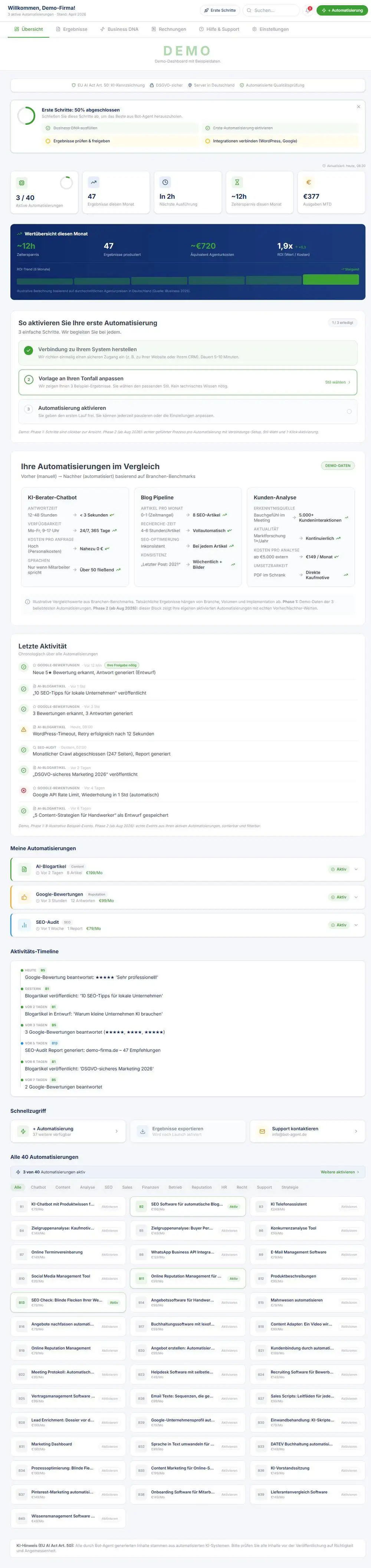 Bot-Agent Bot-Agent |
Platform in preparation for launch; partner network planned | Shares the STEP/SEEDS® technology base; automation capabilities tested internally ahead of public launch. |
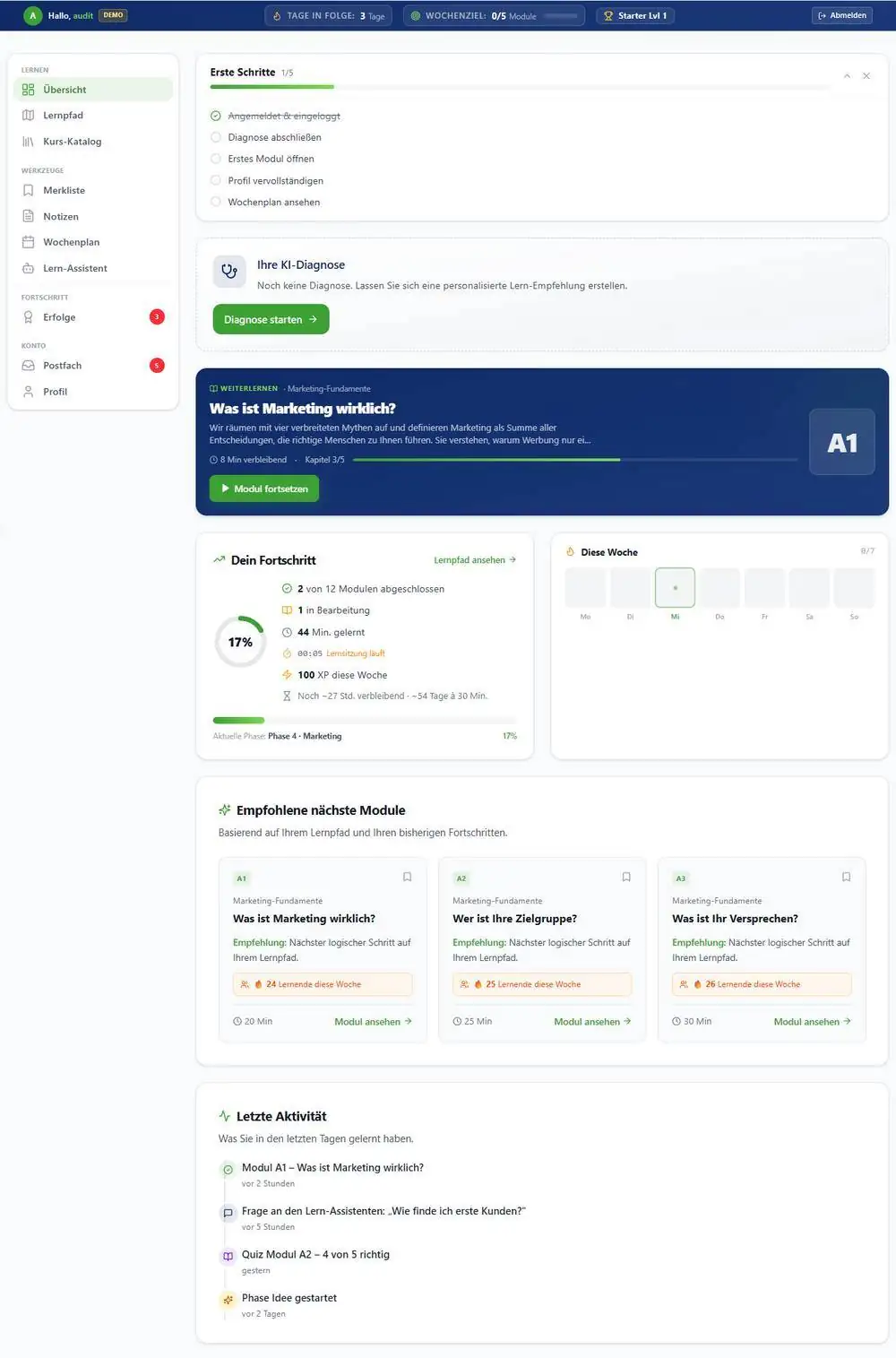 Meine KI-Akademie Meine KI-Akademie |
Functional prototype | Built on the same guided-pathway and AI-mentor pattern as NextBeruf; formal pilot evidence not yet available. |
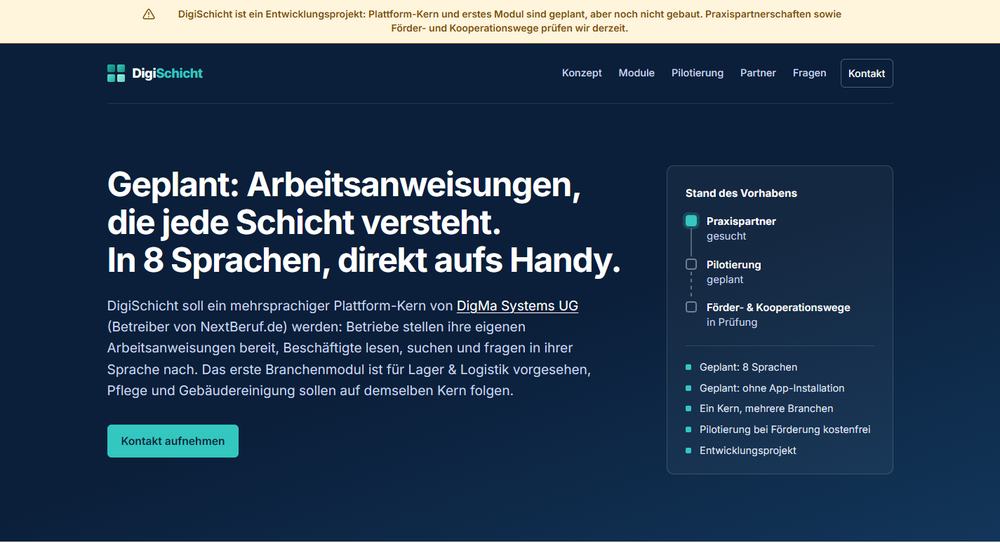 DigiSchicht DigiSchicht |
Concept phase, not yet available | Short digital-skills learning content (5 to 10 minutes, eight languages) for workers in entry-level roles (care, warehousing and logistics, building cleaning), building on the NextBeruf technology base. Several funding and partnership paths are being explored in parallel; no commitment has been secured yet. |
Reusable capabilities matrix
Components already built in our own products that we would bring into an Erasmus+ or other EU-funded project instead of building from scratch.
| Capability | Implemented in | Possible EU-project use |
|---|---|---|
| Internationalisation (i18n) and RTL layout support | Shared platform architecture; right-to-left layout in use on NextBeruf (Arabic) | Multi-language, multi-partner-country rollout of a shared tool or portal |
| Guided, step-by-step pathways | STEP/SEEDS® methodology, NextBeruf orientation flow | Structured learner or user journeys for a training or orientation programme |
| Diagnostics and scoring | STEP/SEEDS® marketing diagnostic, NextBeruf assessment logic | Needs assessment, skills scoring, or readiness diagnostics for target groups |
| AI mentor / assistant layer | KI-Akademie, NextBeruf, Bot-Agent | Conversational guidance support for learners or beneficiaries, with human oversight |
| Workflow automation | Bot-Agent automation layer | Reducing manual admin load for partner organisations (onboarding, follow-up, reporting) |
| Aggregated usage analytics | STEP/SEEDS® tracking dashboard (demo) | Aggregate monitoring of project reach and engagement |
| Structured report generation | STEP/SEEDS® client reports | AI-assisted generation of participant or evaluation reports for consortium deliverables, with human review |
How we work with consortium partners
Co-creation, iterative piloting and how scope and cost are agreed.
We develop our products iteratively, close to users and the market, rather than fixing every feature at launch. We would bring the same approach to a consortium project: build a working version early, test it with real target-group participants, and adjust based on what is actually observed, instead of testing a fixed specification only at the end of the project.
We aim to reuse existing components where suitable instead of rebuilding the same foundation for every product. Because the guided-pathway, diagnostic, AI-mentor and automation building blocks already exist, a project can adapt and extend them. We do not quote fixed prices for work packages here; scope and cost are worked out with each partner based on the specific deliverables required.
Responsible AI and data protection
We state our compliance status as it is and treat it as an ongoing practice.
AI transparency
Across our products, AI is used as an analytical tool that supports human decisions, not as an automated decision-maker. Where AI-generated or AI-assisted content or interaction is presented to users, we label it, with the aim of meeting the transparency obligations of Art. 50 of the EU AI Act.
Data protection status
Data protection details are set out in the privacy notice of each product.
Background IP and project-funded outputs
A clear line between what we bring into a project and what a project would produce.
Background IP (ours, brought into a project)
- The shared technology base: guided-pathway engine, diagnostic and scoring logic, AI mentor layer, automation framework
- The STEP/SEEDS® methodology and trademark, personally owned by Stanislav Tonkich, used by DigMa Systems UG with the owner's consent; a written licence agreement is being prepared
- Existing product codebases
- Operational know-how from developing and running these platforms, including internal test runs
Project-funded outputs (ownership and licensing follow the grant agreement and the consortium agreement)
- New features, modules, or content built specifically for the funded project
- Translations, localisations, and adaptations produced for partner countries
- Evaluation data, pilot results, and reports generated within the project
- Any new training materials or curricula co-developed with partners
Talk to us
If you are assembling an Erasmus+ or other EU-funded consortium and need a technology partner, get in touch.
Get in touch